
Historic places in the UK you need to visit
The UK has a long and fascinating history. According to the BBC, footprints were found on the shores of Happisburgh that were more than 800,000 years old. 1 These footprints are the earliest known human footprints in Northern Europe and the earliest evidence of footprints outside of Africa.
Historical events have shaped the way we live today, and several sites across the nation offer an insight into the UK’s rich history. Whether it’s a castle, a tower, or a museum, it can be a fascinating, culture enriching way of getting outside and spending time with the family.
But where are the UK’s most impressive historic sites?
To answer that question, here at GO Outdoors we’ve delved into the data on the UK’s top historical sites. To find out which are the best, we’ve looked into the following:
- The affordability
- Google reviews
- Tripadvisor reviews
- Monthly Google searches
After digging through the data, we’ve revealed the best historical days out. So, lace up your walking boots, pack a waterproof jacket, and get exploring the best historical days out that the UK has to offer.
Jump to:
- The best historical days out in the UK
- The best historical day out in Wales
- The best historical day out in Northern Ireland
- The best UK castles to visit
- The best place for a Neolithic day out
- The cheapest historical day out
- The most popular historical day out
- Methodology
The best historical days out in the UK
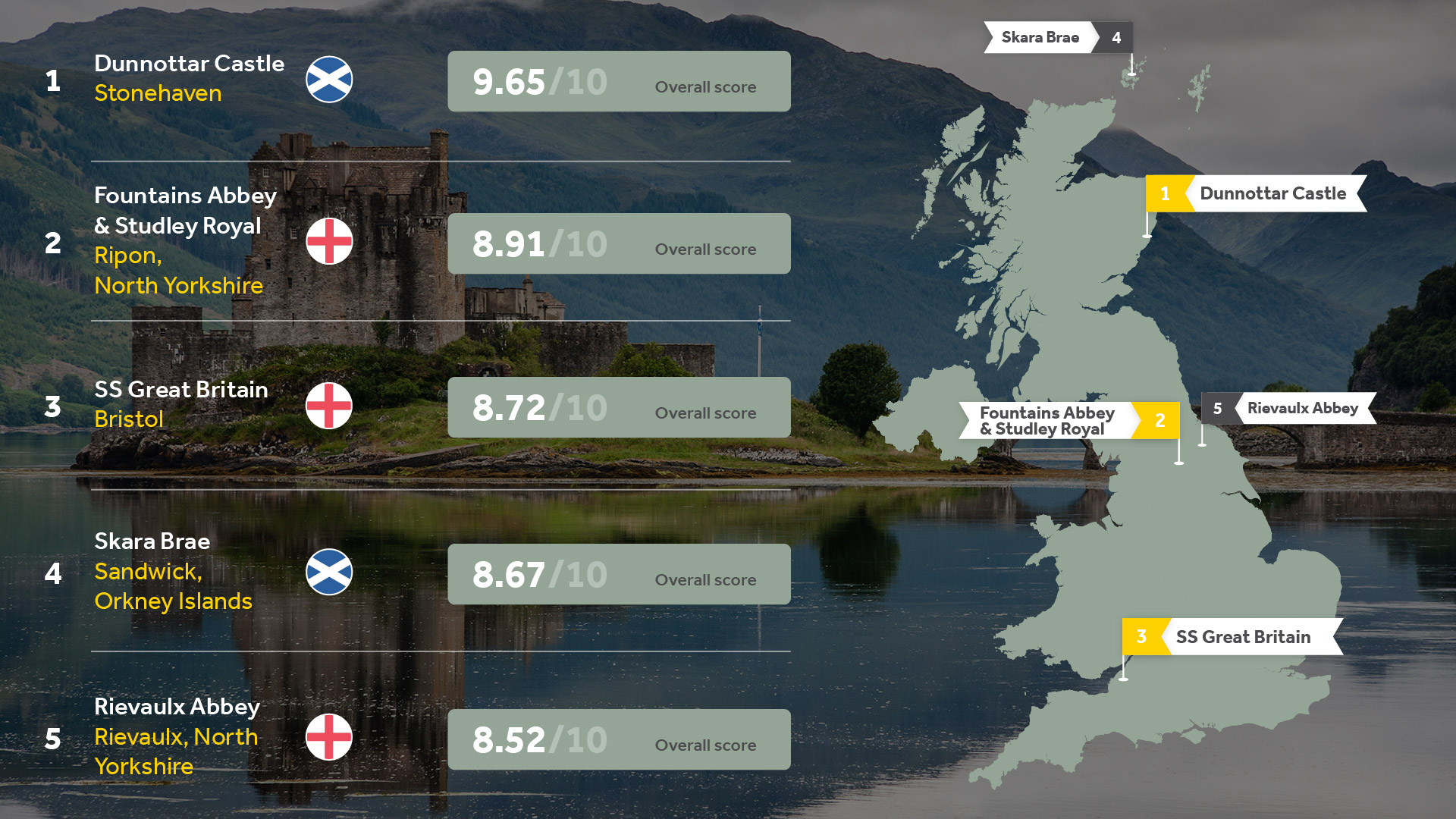
| Rank | Historical site | Location | County | Date of origin | Suggested time spent at the attraction | Admission cost (2 adults + 2 children) | Google review score /5 | Tripadvisor score /5 | Average monthly searches | Overall score /10 |
| 1 | Dunnottar Castle | Stonehaven | Scotland | 1276 AD | 1-2 hours | £38.00 | 4.8 | 4.8 | 40,500 | 9.65 |
| 2 | Fountains Abbey & Studley Royal | Ripon, North Yorkshire | England | 1132 AD | >3 hours | £52.50 | 4.8 | 4.7 | 60,500 | 8.91 |
| 3 | SS Great Britain | Bristol | England | 1843 AD | 2-3 hours | £44.00 | 4.8 | 4.8 | 18,100 | 8.72 |
| 4 | Skara Brae | Sandwick, Orkney Islands | Scotland | 3200 BC | 1-2 hours | £40.50 | 4.7 | 4.8 | 40,500 | 8.67 |
| 5 | Rievaulx Abbey | Rievaulx, North Yorkshire | England | 1132 AD | 1-2 hours | £30.80 | 4.7 | 4.7 | 22,200 | 8.52 |
| 6 | Pembroke Castle | Pembrokeshire | Wales | 1093 AD | >3 hours | £41.00 | 4.7 | 4.8 | 27,100 | 8.42 |
| 7 | Ulster Folk Museum | Cultra, County Down | Northern Ireland | 1958 AD | 2-3 hours | £29.50 | 4.7 | 4.6 | 18,100 | 7.93 |
| 8 | York Minster | York, North Yorkshire | England | 627 AD | >3 hours | £40.00 | 4.7 | 4.5 | 110,000 | 7.88 |
| 9 | Tower of London | London | England | 1066 AD | 2-3 hours | £107.40 | 4.7 | 4.6 | 550,000 | 7.59 |
| 9 | Windsor Castle | Windsor, Berkshire | England | 1070 AD | 2-3 hours | £93.00 | 4.7 | 4.6 | 368,000 | 7.59 |
| 9 | St Paul’s Cathedral | London | England | 604 AD | 1-2 hours | £62.00 | 4.7 | 4.5 | 368,000 | 7.59 |
- The best historical day out is at Dunnottar Castle, with an overall score of 9.65/10
A family-friendly historical site that you need to visit is Dunnottar Castle, with a score of 9.65 out of 10. Dunnottar Castle scores consistently high across the board, with its low admission cost and overwhelmingly positive Google and Tripadvisor reviews.
In its earliest days, Dunnottar defended the Scottish coast from Viking raids before being used during the Wars of Independence. Eventually, it was chosen as the safest place to hide Scotland’s crown jewels, in other words, the Honours of Scotland. Its significance was recognised by monarchs visiting Aberdeenshire, with all choosing to visit this clifftop castle. However, by the 1700s, the novelty of living in a cold castle by the coast had gone, causing Aberdeen’s stunning landmark to be left to ruin.
However, one drawback to this historic site is its access. Public transport to the castle is pretty limited. If you fancy an easy hike, walking from Stonehaven will take less than an hour. If not, then you can always visit by car.
- Fountains Abbey & Studley Royal is the second-best historical day out, scoring 8.91/10
In second place is Fountains Abbey and Studley Royal, with a score of 8.91 out of 10. This ancient abbey is a little costlier than some of our other historic days out. However, it’s well reviewed and is a popular choice for a historical day out. For a family of four, it will cost just over £50, but this water garden is well worth it. The suggested time spent here is over three hours, giving you plenty of opportunity to appreciate its breathtaking views.
The abbey was founded when 13 Benedictine monks escaped York seeking a simpler way of life. After three years of settling at the fountains, they were admitted to the Cistercian Order, where they were introduced to the system of lay brothers, known today as labourers. This gave the monks more time to dedicate themselves to God, as the lay brothers would take care of the farming.
The abbey is fairly quiet, meaning you can take in the history of this fascinating site without any distractions. That being said, it’s a great place for a family hike. The scenery really makes the experience, so make sure to take photos to capture the beauty of the day. There is also a beach below the castle, so you can enjoy the sandy coast once you’ve finished exploring.
- The SS Great Britain is the third best site for a historical day out, with a score of 8.72/10
Our top three is completed by the SS Great Britain, with a day out here earning a score of 8.72 out of 10. SS Great Britain is now a museum ship in Bristol. But two centuries ago, she was a record-breaking phenomenon. SS Great Britain was the first of its kind:
- The first iron steamer to cross the Atlantic Ocean, which she did in 14 days
- At the time of her construction, she was, by far, the largest ship in the world
- She was the first large-scale iron-hulled and screw-propelled ocean-going ship.
- On its maiden voyage, she was the fastest ship in the world.
SS Great Britain had a wonderful career as a luxury liner and cargo ship. She completed 47 voyages, including 32 to Australia, carried over 30,000 passengers and crew, and travelled to five different countries. Sadly, this historic ship was damaged by storms in the 1880s, and before her return to Bristol’s dry dock, she worked as a floating store in the Falkland Islands.
SS Great Britain is the joint highest ranked historical day out on Google and Tripadvisor, scoring 4.8 out of five on each review site. Enjoying this piece of history will cost a family of four £44, which is slightly below the average cost on our list.
The suggested time you should spend here is between two and three hours. Once you’ve finished exploring, SS Great Britain is just a stone’s throw away from Bristol’s city centre. There are a few places to eat and drink by the docks, but if you fancy shopping and a walk around the city centre, you’ll be able to do so in no time.
The best historical day out in Wales
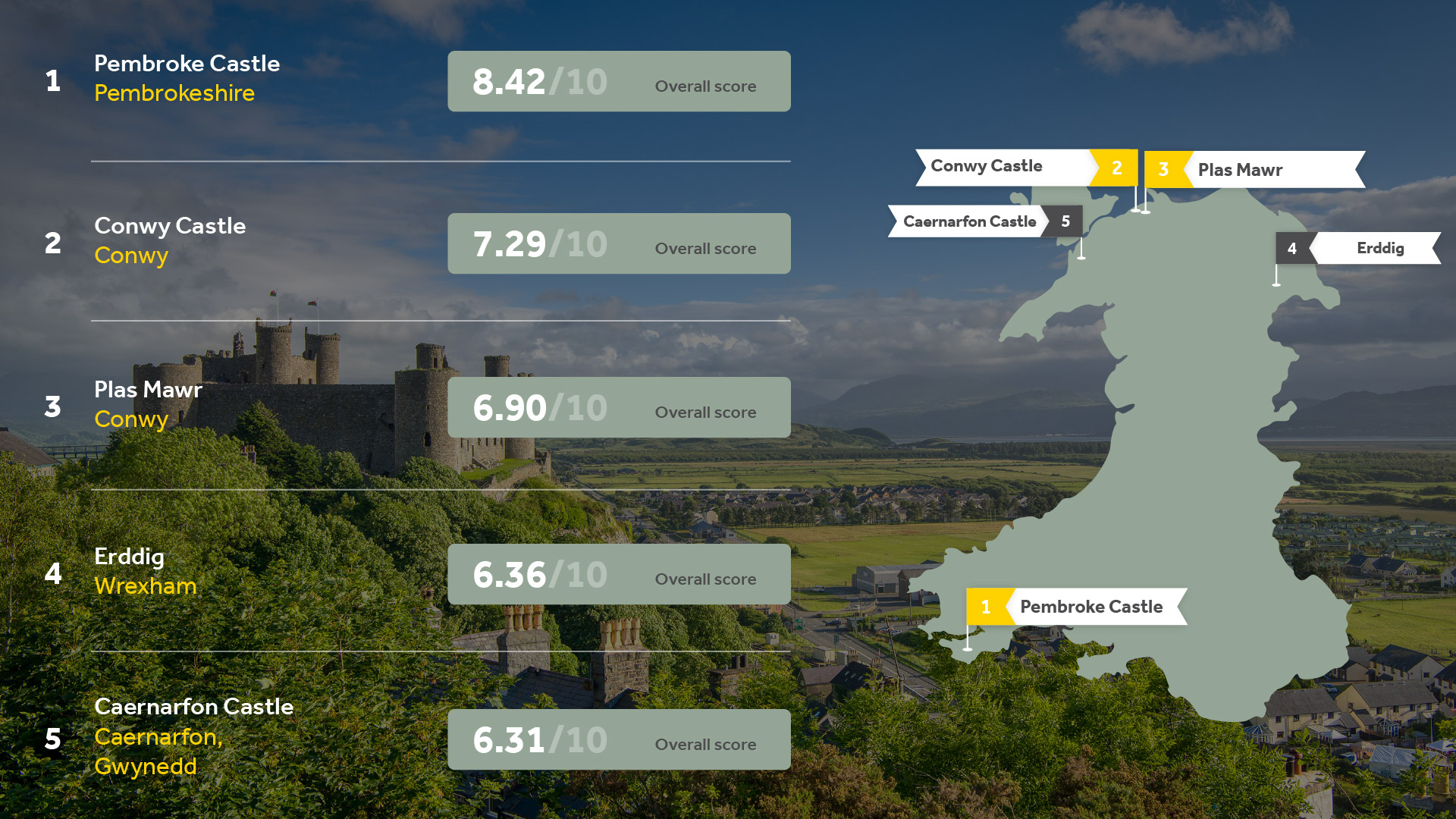
| Rank | Historical site | Location | Suggested time spent at the attraction | Admission cost (2 adults + 2 children) | Google review score /5 | Tripadvisor score /5 | Average monthly searches | Overall score /10 |
| 1 | Pembroke Castle | Pembrokeshire | >3 hours | £41.00 | 4.7 | 4.8 | 27,100 | 8.42 |
| 2 | Conwy Castle | Conwy | 2-3 hours | £42.00 | 4.7 | 4.5 | 60,500 | 7.29 |
| 3 | Plas Mawr | Conwy | 1-3 hours | £35.60 | 4.8 | 4.4 | 4,400 | 6.90 |
| 4 | Erddig | Wrexham | 2-3 hours | £33.00 | 4.7 | 4.4 | 9,900 | 6.36 |
| 5 | Caernarfon Castle | Caernarfon, Gwynedd | >3 hours | £48.70 | 4.6 | 4.6 | 40,500 | 6.31 |
| 6 | Beaumaris Gaol | Anglesey | 1-3 hours | £23.00 | 4.6 | 4.6 | 1,000 | 6.22 |
| 7 | Cardiff Castle | Cardiff | 1-2 hours | £42.50 | 4.6 | 4.4 | 74,000 | 5.87 |
| 8 | Castell Henllys Iron Age Village | Pembrokeshire | 1-2 hours | £30.00 | 4.6 | 4.5 | 1,600 | 5.43 |
| 9 | Tredegar House | Newport | 2-3 hours | £39.00 | 4.6 | 4.4 | 12,100 | 5.23 |
| 10 | Smallest House in Britain | Conwy | <1 hour | £5.00 | 4.4 | 4.2 | 2,900 | 4.70 |
- Pembroke Castle is Wales’ best historical day out, with a score of 8.42/10
Our best historical day out in Wales, and sixth best in the UK, is Pembroke Castle, with a score of 8.42 out of 10. The history of this castle dates back to 1093 AD. The Earl of Shrewsbury, Roger de Montgomery, established his base here after the death of Rhys ap Twedwr, the last Prince of South-West Wales.
This basic structure was continuously renovated and improved as it passed ownership from Richard de Clare, then to William Marshal, and eventually to William de Valence, who strengthened it by building walls and towers around the Outer Ward. William de Valence, who was also a half-brother of Henry III, even added a new suite of domestic buildings in the Inner Ward and strengthened the town by creating a ring of walls with three main gates and a postern.
De Valence’s efforts to make this castle invincible were not flawless. Following the Tudor era, the English Civil War broke out, and Pembroke Castle became a Parliamentarian Stronghold. After a Parliamentary victory, a new rebellion broke out in 1648, and Pembroke Castle suffered significant damage under the orders of the Parliamentary Army’s Lieutenant-General, Oliver Cromwell.
Despite this enormous damage, Major-General Sir Ivor Philipps bought it in 1928 and has thankfully restored Pembroke Castle to its former glory. His efforts have clearly been a success, with visitors rating it highly on Google and TripAdvisor. It might not be the most searched historical day out, but for a family of four, it’s relatively affordable at just £41. There are also lots of pubs, cafes, and restaurants in the neighbouring area, meaning you can grab a bite to eat with the family afterwards.
The best historical day out in Northern Ireland
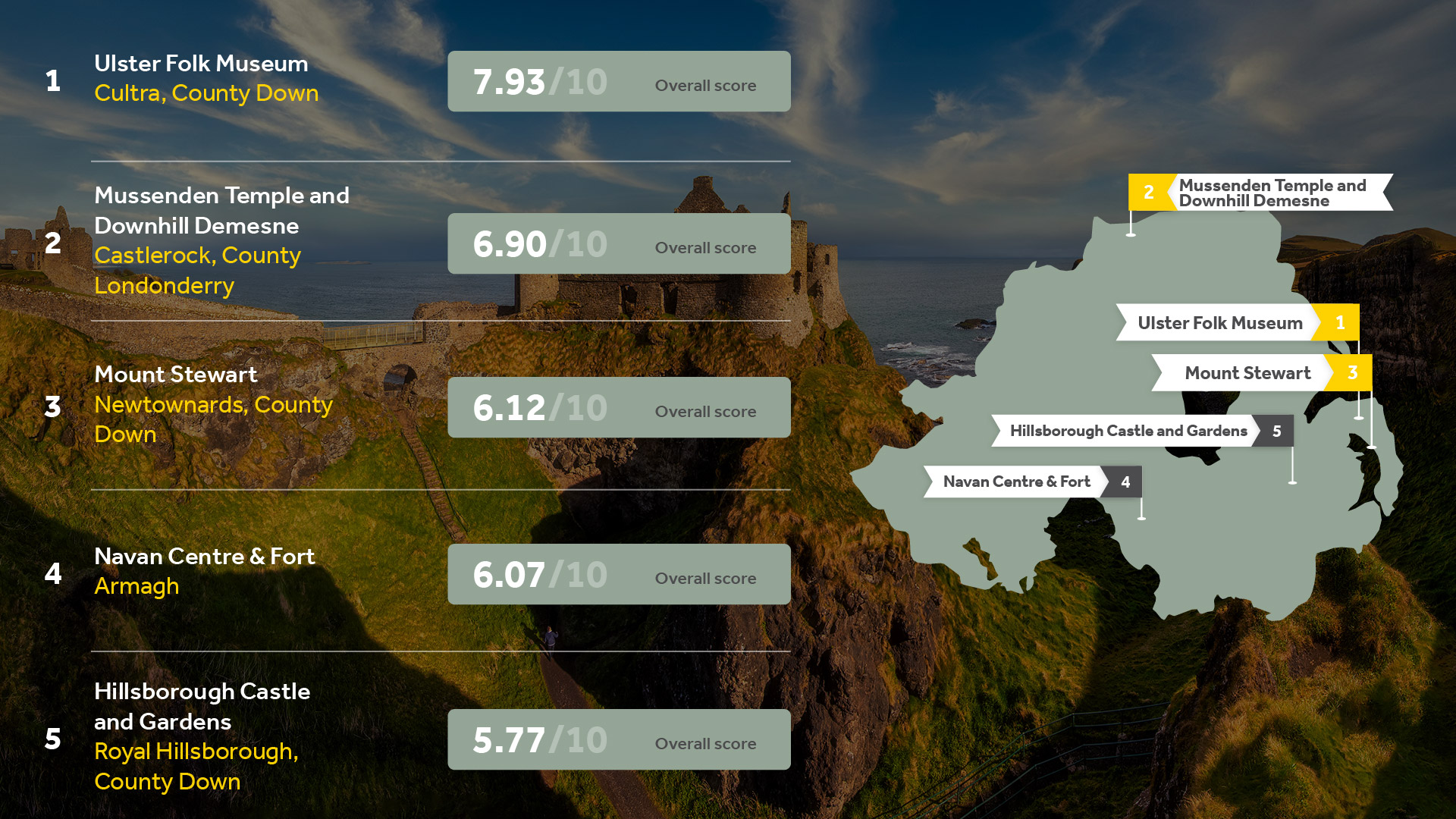
| Rank | Historical site | Location | Suggested time spent at the attraction | Admission cost (2 adults + 2 children) | Google review score /5 | Tripadvisor score /5 | Average monthly searches | Overall score /10 |
| 1 | Ulster Folk Museum | Cultra, County Down | 2-3 hours | £29.50 | 4.7 | 4.6 | 18,100 | 7.93 |
| 2 | Mussenden Temple and Downhill Demesne | Castlerock, County Londonderry | 1-2 hours | £0.00 | 4.7 | 4.4 | 9,900 | 6.90 |
| 3 | Mount Stewart | Newtownards, County Down | 2-3 hours | £45.00 | 4.7 | 4.5 | 12,100 | 6.12 |
| 4 | Navan Centre & Fort | Armagh | 2-3 hours | £42.00 | 4.6 | 4.7 | 1,600 | 6.07 |
| 5 | Hillsborough Castle and Gardens | Royal Hillsborough, County Down | 2-3 hours | £62.40 | 4.7 | 4.5 | 14,800 | 5.77 |
| 6 | Crumlin Road Gaol | Belfast | 1 hour | £45.00 | 4.6 | 4.6 | 12,100 | 5.72 |
| 7 | Crom Estate | Newtownbutler, County Fermanagh | 2-3 hours | £27.00 | 4.6 | 4.5 | 480 | 5.48 |
| 8 | Carrickfergus Castle | Carrickfergus, County Antrim | 1-3 hours | £18.00 | 4.5 | 4.3 | 14,800 | 5.43 |
| 9 | Titanic Belfast | Belfast | 1-2 hours | £62.00 | 4.5 | 4.4 | 74,000 | 5.09 |
| 10 | Castle Ward | Downpatrick, County Down | >3 hours | £42.00 | 4.6 | 4.3 | 6,600 | 4.45 |
- The best site for a historical day out is Ulster Folk Museum, with a score of 7.93/10
Ulster Folk Museum is an incredibly unique experience. It was designed as a traditional open-air museum and opened to the public in 1964. But what makes this place so special? It gives you an insight into the social life of the northern counties in Ireland in the early 20th century.
Ulster Folk Museum takes inspiration from Skansen, the oldest open-air museum in the world. Like Skansen, Ulster Folk Museum is a collection of heritage buildings and objects demonstrating the traditions, stories, and skills passed down through generations. The team at Ulster Folk Museum showcases the traditional tools and techniques used for:
- Stained glass making
- Willow and linen weaving
- Carpentry
- Blacksmithing
Ulster Folk Museum also enlightens you on what entertainment was like in the 20th century, showing you film screenings and traditional music. This hands-on experience will cost less than £30 for a family of four and is the joint-highest reviewed historical site in Northern Ireland.
The best UK castles to visit
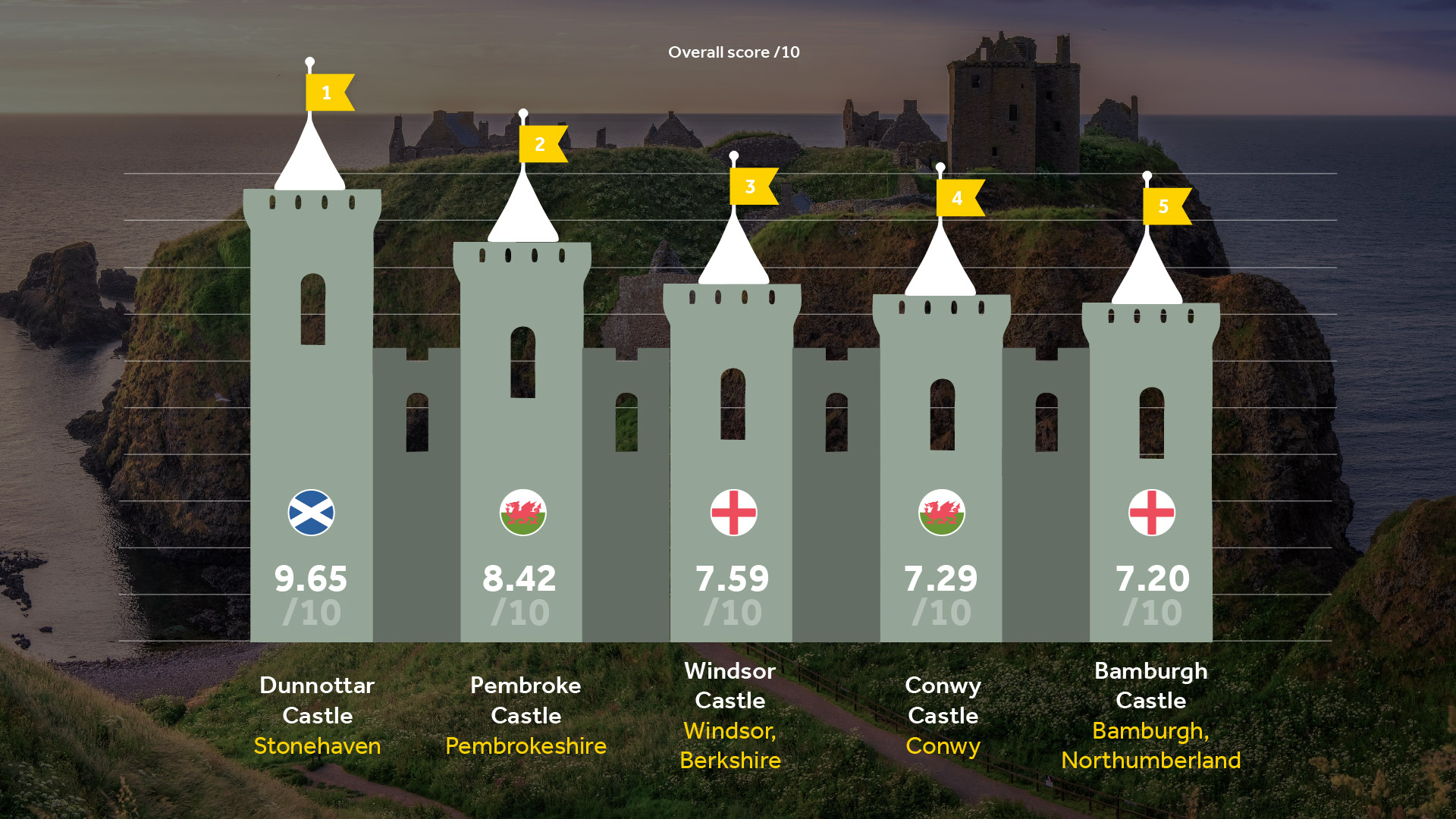
| Rank | Historical site | Location | County | Date of origin | Suggested time spent at the attraction | Admission cost (2 adults + 2 children) | Google review score /5 | TripAdvisor score /5 | Average monthly searches | Overall score /10 |
| 1 | Dunnottar Castle | Stonehaven | Scotland | 1276 AD | 1-2 hours | £38.00 | 4.8 | 4.8 | 40,500 | 9.65 |
| 2 | Pembroke Castle | Pembrokeshire | Wales | 1093 AD | >3 hours | £41.00 | 4.7 | 4.8 | 27,100 | 8.42 |
| 3 | Windsor Castle | Windsor, Berkshire | England | 1070 AD | 2-3 hours | £93.00 | 4.7 | 4.6 | 368,000 | 7.59 |
| 4 | Conwy Castle | Conwy | Wales | 1283 AD | 2-3 hours | £42.00 | 4.7 | 4.5 | 60,500 | 7.29 |
| 5 | Bamburgh Castle | Bamburgh, Northumberland | England | 547 AD | 2-3 hours | £55.00 | 4.7 | 4.5 | 110,000 | 7.20 |
| 6 | Dover Castle | Dover, Kent | England | 1066 AD | >3 hours | £68.10 | 4.7 | 4.6 | 60,500 | 7.05 |
| 7 | Caernarfon Castle | Caernarfon, Gwynedd | Wales | 1283 AD | >3 hours | £48.70 | 4.6 | 4.6 | 40,500 | 6.31 |
| 8 | Stirling Castle | Stirling | Scotland | 1110 AD | <1 hour | £53.00 | 4.6 | 4.5 | 90,500 | 6.12 |
| 9 | Edinburgh Castle | Edinburgh | Scotland | 1130 AD | >3 hours | £62.00 | 4.6 | 4.4 | 301,000 | 5.97 |
| 9 | Leeds Castle | Maidstone, Kent | England | 1119 AD | >3 hours | £83.00 | 4.7 | 4.3 | 110,000 | 5.97 |
- Dunnottar Castle is the best to visit in the UK, with a score of 9.65/10
Not only is Dunnottar Castle the best place in the UK for a historical day out, it’s also the best castle. It’s clear why this castle has earned a score of 9.65 out of 10. These cliff-top ruins are packed with history and were once the fortress of one of the time’s most powerful families in Scotland, the Earl Marischal.
The great Marischal of Scotland, Sir William Keith, who later became the 1st Earl Marischal, built the first stone castle at Dunnottar, which is now known as The Keep. George Keith, the 5th Earl Marischal, continued to add buildings to Dunnottar. Most notably, he added The Lion’s Den in 1593, which housed Keith’s pet lion.
However, the Earl Marischal’s history in Dunnottar ended with the 10th person to hold this title, also named George Keith. In 1715, he was a key figure in the failed Jacobite Rising to overthrow King George I. As a result of his involvement, Keith was forced to forfeit his title and estates, meaning that the property was sold in 1717 by the government to the York Building Company.
- The second-best castle in the UK is Pembroke Castle, with a score of 8.42/10
In second place is Pembroke Castle, with a score of 8.42 out of 10. Pembroke Castle is also the best historic day out in Wales, making its second-place ranking unsurprising.
Underneath the castle lies Wogan Cavern, which has become a nationally important archaeological site. In July 2022, the Natural History Museum and the British Cave Research Society funded an archaeological survey that found evidence of prehistoric megafauna, including reindeer and woolly mammoths. The evidence suggests that Wogan Cavern was occupied by residents as far back as the Palaeolithic and Mesolithic Periods.
- Windsor Castle is England’s best castle, with a score of 7.59/10
Our top three is concluded by Windsor Castle, scoring 7.59 out of 10. Windsor Castle is well-reviewed by its visitors, scoring 4.7 out of five and 4.6 out of five on Google and Tripadvisor, respectively. It is a little pricey. However, it’s the most popular castle on our list, with almost 370,000 monthly Google searches.
Windsor Castle is the oldest and largest occupied castle in the world. It has 1,000 years of royal history, and since it was founded by William the Conqueror in the 11th century, it has been the home of 40 monarchs.
Originally, it was built as a motte-and-bailey, designed to project Norman dominance around the outskirts of London and oversee an important part of the River Thames. It wasn’t until the 13th century that Henry III converted it into a luxury royal palace. Edward III then took this one step further, overseeing the most expensive secular building project of the entire Middle Ages in England. Edward’s design reached the Tudor Period, when Henry VIII and Elizabeth I used it as a royal court and centre for diplomatic entertainment. This castle has been a lasting part of history, surviving:
- The First Barons’ War
- The English Civil War
- The First World War
- The Second World War
However, it was neglected during the 18th century until George III and George IV renovated it at a colossal expense. It also survived a fire in 1992, which caused £36.5 million worth of damage. To help pay for this restoration, it was opened to the public and now makes for a fascinating day out.
After you’ve finished exploring, grabbing a bit to eat before you head home will not be a challenge. Nearby are plenty of restaurants and cafes to enjoy a family meal. And if you go in the morning, you should have time to go to London, where the possibilities are endless.
The best place for a Neolithic day out
- Navan Centre and Fort is the best place for a Neolithic day out, with a date of origin of 4000 BC
Dating back to 4000 BC, Navan Centre and Fort is the oldest site for a historical day out on our list. Situated just two miles away from Armagh, it is one of Northern Ireland’s most famous and important archaeological sites.
According to tradition, the fort is one of the great royal sites of pre-Christian Gaelic Ireland and the capital of Ulaidh. It is believed to have been a ceremonial, sacred space prominently featured in Irish mythology. It is especially referenced in the tales of the Ulster Cycle, a body of medieval Irish heroic legends and sagas of the Ulaid.
The cheapest historical day out
- Mussenden Temple and Downhill Demesne is an affordable historical site, with free entry
If you want to visit Mussenden Temple and Downhill Demesne, you only have to pay for parking, making it the most affordable historic day out on our list. Downhill House was built as a family home for the Earl Bishop in the 18th century. However, what remains now are its ruins after a fire in 1851. It did remain in the family until at least 1948, though it was rarely used. During the Second World War, the RAF requisitioned it and, following the war, dismantled it, removing the roof.
The Mussenden Temple was also built for the Earl Bishop, originally intended as a library. It was inspired by the Temple of Vesta in Italy and was given to his cousin’s daughter as a wedding gift. Unfortunately, she died in 1785, two years after the Temple’s completion, and it became her memorial.
The temple has become a national landmark, and according to the National Trust, it’s one of the most photographed places in Northern Ireland. It sits right on the cliff edge at Downhill Demesne and is a stunning piece of architecture.
This historical site is in a slightly isolated area, so if you want to continue exploring, you’ll likely need to drive or get a taxi. However, not too far from Mussenden Temple and Downhill Demesne is a beach, giving you a chance to relax with the family.
The most popular historical day out
- The most searched historical day out is the Tower of London, with 550,000 Google searches every month
The official name of the Tower of London is His Majesty’s Royal Palace and Fortress of the Tower of London. It’s a historical citadel and castle on the north bank of the River Thames. William the Conqueror built it in 1078 and has had several purposes over its long-standing history, including:
- A royal residence
- A prison (between 1100 and 1952)
- An armoury
- A treasury
- A menagerie
- The home of the Royal Mint
- A public record office
- The home of the Crown Jewels of England
The Tower of London is a World Heritage Site, and has been a tourist attraction since the Elizabethan period, becoming one of the most popular in London. Its most popular attractions include the Royal Menagerie, displays of armour, and the Crown Jewels, which have been on public display since 1669.
If you still want to explore after your visit to the Tower of London, Tower Bridge and St. Paul’s Cathedral are nearby. There are also plenty of restaurants, cafes, and bars to enjoy if you visit later in the day.
Methodology
We created a list of historical spots in the UK using sources such as:
We then used the individual websites to find the cost of a family ticket (if offered); otherwise, we found the total cost of two adult and two child tickets, using the following criteria:
- Tickets purchased in advance online, where available.
- No donations or Gift Aid contributions included.
- Peak-rate pricing applied (summer season, weekends, and holidays)
- Two children of paying age, unless the attraction is fully free for children.
We used TripAdvisor to find the average rating of the spot.
Also, we collected the Google rating for each spot.
We used Google Keyword Planner to find the average monthly searches for each destination between July 2024 and June 2025.
As well as this, we collected information on the origin date of the historical spots from various sources, and the average visiting time from Tripadvisor and various other sources.
All data was collected in August 2025 and is correct as of then.
Sources:
Earliest footprints outside Africa discovered in Norfolk – BBC
